
Goal:
Find opportunity areas in unmet needs of alumni for the University of Illinois.
Solution:
Reimagine the “moments that
matter most” for alumni of all ages
Impact:
Improved donations and creation of student travel program to meet with alumni
Led by a team of Siebel Center for Design staff, interns, and students,
Team Donor Journey (DJ, for short) identified new development strategies based on the behaviors and unmet needs of otherwise disengaged alumni. Their vision infuses students into every area of the advancement operations, beyond traditional student ambassadors, student callers, interns, and event speakers.
Secondary Research
We interviewed 21 people in four parts of University Advancement:
– UIF (University of Illinois Foundation)
– OVCIA (Office of the Vice Chancellor for Institutional Advancement)
– UIAA (University of Illinois Alumni Association)
– MGO (Major Gift Officers)

Some of the UIUC employees we spoke to

An aerial view of analyzing interviews. Post-it’s are a must in the Design Thinking process!
What We Heard
1. Big donations matter most
2. University scale and decentralization hinder efficacy
3. Rebuilding is a constant reality
4. Limited resources and high turnover mean relationship building at every capacity is challenging
5. There’s a true passion for establishing meaningful relationships with the University
We interviewed 28 diverse Illinois alumni from across the country.
These included alumni who had never given as well as a group we called the “dormant donors”: alumni who previously gave to the university but have not within the past 10 years. Alumni had a range of different majors, graduation years, race, and current employment.
Field Research
We interviewed 28 diverse Illinois alumni from across the country. These included alumni who had never given as well as a group we called the “dormant donors”: alumni who previously gave to the university but have not within the past 10 years. Alumni had a range of different majors, graduation years, race, and current employment.

Our interviews led us to identify eight behavioral personas. Use the slider to reveal them below!


These eight personas are mapped on a matrix of Responsive / Closed Off (to university messaging) and Unlikely to Give / Likely to Give (money to the university). The Goldilocks Zone for the UIF was the top-right quadrant: Responsive and Likely to Give.
We decided that the most difficult groups to move into this quadrant would be those Scorned or Unhappy and Indifferent (they wouldn’t answer our calls anyway!). We resolved to focus on groups whose minds we knew we could change, circled below:

These three circled personas were very distinct but each was an important persona to study.
“My Money Could Go Further Elsewhere”: Alumni who chose other causes than Illinois.
“No One Asked Me”: Alumni who wanted a personal touch or never received messaging.
“People, Not Place”: Alumni who loved Illinois for the friends they made. Once those friends were gone, so was their connection to Illinois.
The Donor Journey
The most difficult part of this project was defining a the journey of a single donor, given that each alumnus has a different story.
UX work thrives when it makes users feel empowered to be unique. We wanted to show each alumnus that their stories were special.
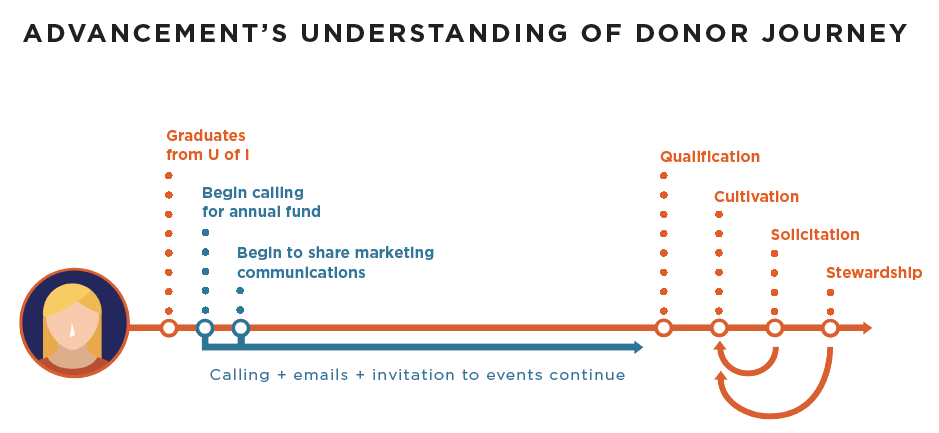
Shown at right is Advancement’s understanding. They have an opt-in strategy that continues until an individual has been identified as a potential prospect for a “major gift” (lots of money!). Then they begin the four-step engagement process, shown here as a loop.
(click to enlarge)
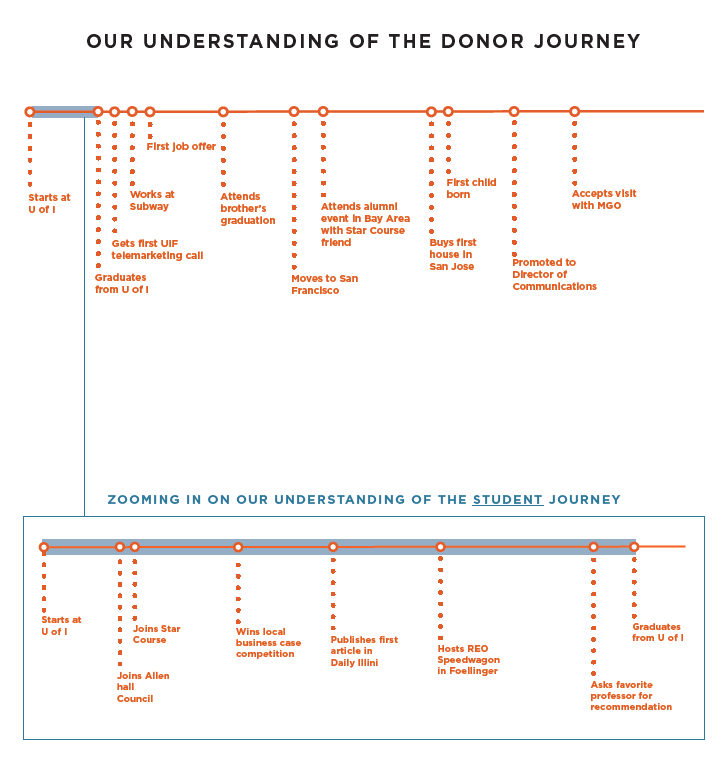
However, this donor journey didn’t exactly line up with what we heard from the alumni.
(click to enlarge)
Shown in two parts at left, the alumni begins their time at Illinois with a variety of highlights during their stay. This timeline serves as a pastiche of many of the “moments that matter” we heard from alumni rather than a strict recitation.
The most important parts of this journey are the times one spends outside of class: dormitories, dining halls, and extracurriculars are fundamental in personal development and forming university relationships.
Understanding and appreciating these moments is critical for cultivating passionate donors. Once they graduate, they have minimal involvement with the university.
Now we were able to see the overlaps, gaps, and opportunities for expanding Advancement’s understanding of the journey.
They must include the moments that matter!
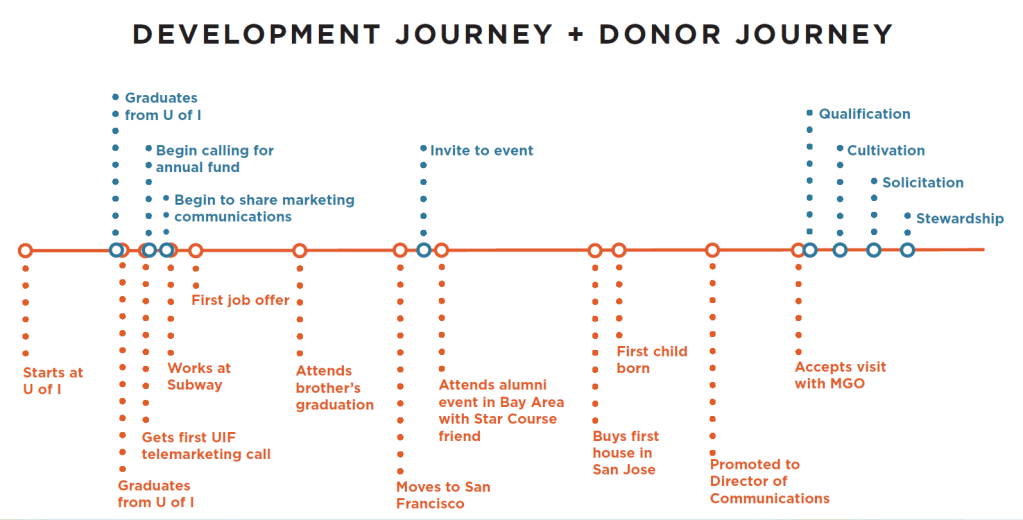
Below our team took the donor journey framework one step further and mapped engagement over time. Use the slider!


5 Opportunities
1. Highlight extracurriculars that alumni love
2. Bet on the underdog
3. Leverage people’s trust in their friends and communities
4. Be present in moments of transition
5. Create and facilitate opportunities for alumni to give their time to students

Click to see full document!
Although all these understandings are important, I will expand on just the first one here. The rest can be explored in our strategy document above.cument
Opportunity #1:
Highlight extracurriculars that alumni love.
“[An RSO] was the beginning of my social life and all the people I’ve stayed connected with.”
-Michael
After lots of contemplation, we finally came up with our mission statement that included all our insights.
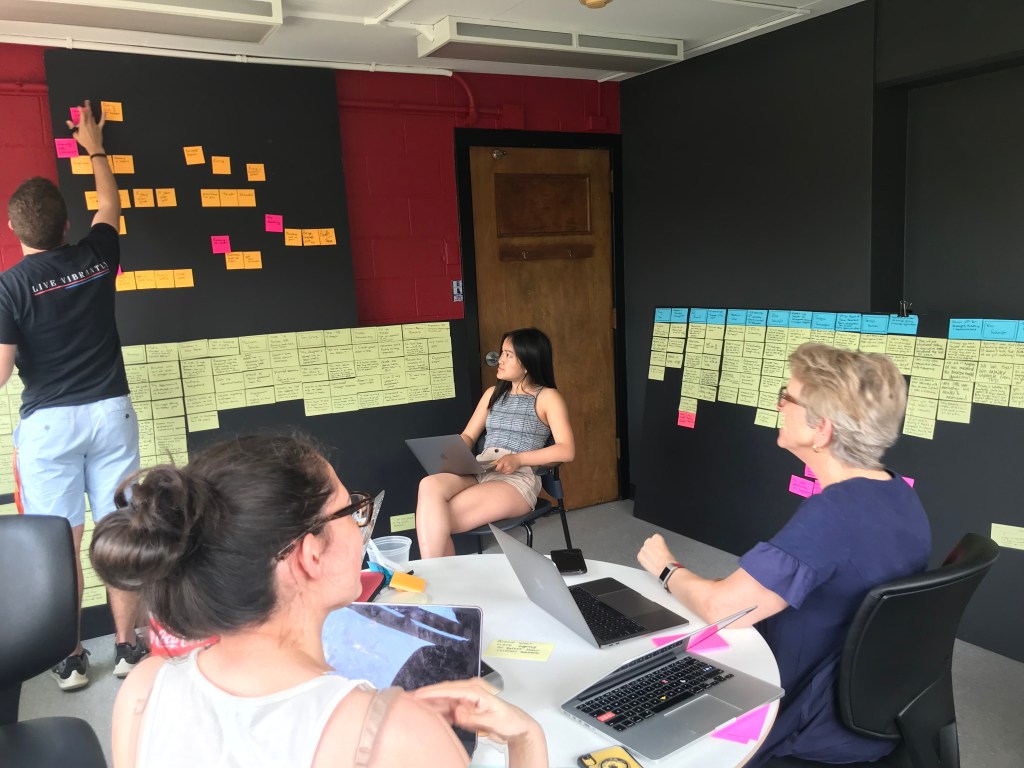
Our office for Project DJ!
How Might We…
…create a mutually beneficial culture of undergraduate student engagement with Advancement?
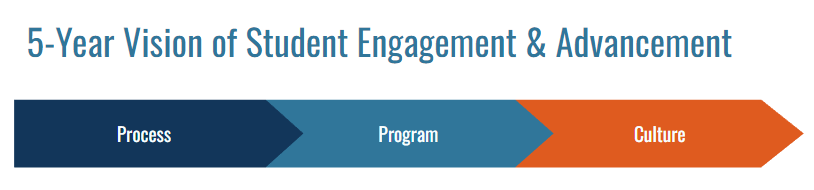
Utilize existing processes to embed students within Advancement
Create new programs
to improve Advancement
and student relationship
Develop more symbiotic relationship between Advancement and undergraduate students
After months of research, our most refined process opportunity was to implement a program called Advancement Liaisons.
Students accompany MGOs on prospect and cultivation visits as a means of reminding alumni of their experiences and connections to the University.
- Provides alumni with first-person exposure to current campus life.
- Establishes a personal connection with an alum that an MGO might not be able to provide.
- Incentivizes UIF + Advancement cooperation with organizations.
- Enhances current student experience by providing valuable alumni connections, building leadership and interpersonal skills, and connecting them with Advancement as a career path.
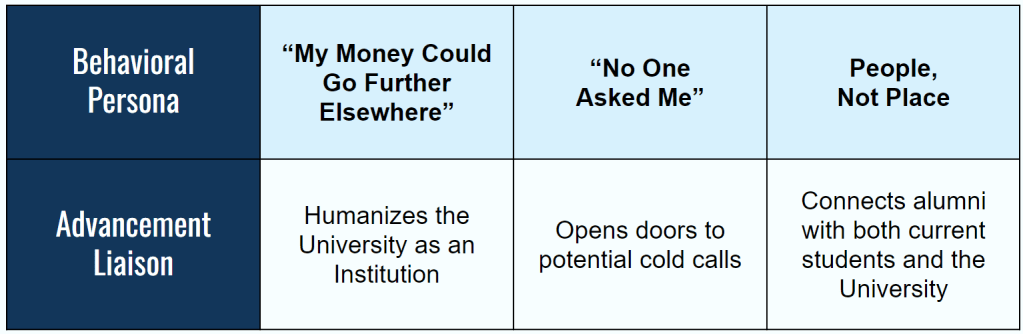
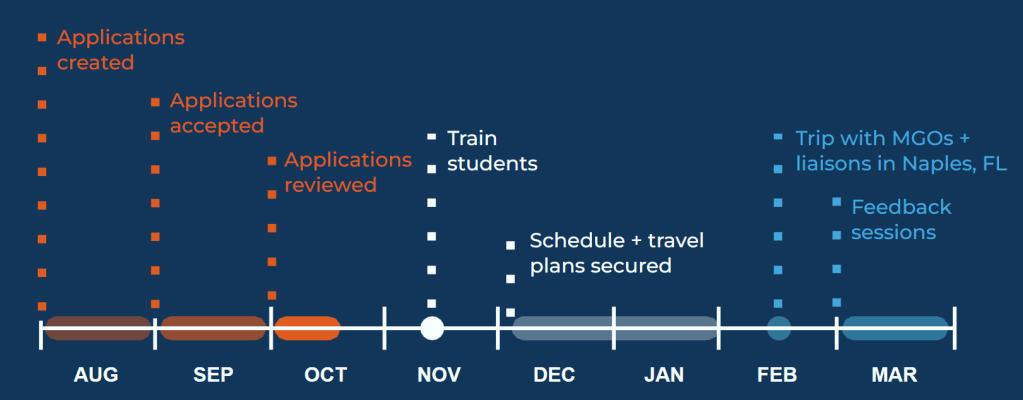
Above is how the Advancement Liaison connects to each of the three personas we were targeting. Below is an implementation timeline.
 Alastair Merrett